The Best LED Color Temperature for Kids Bedrooms
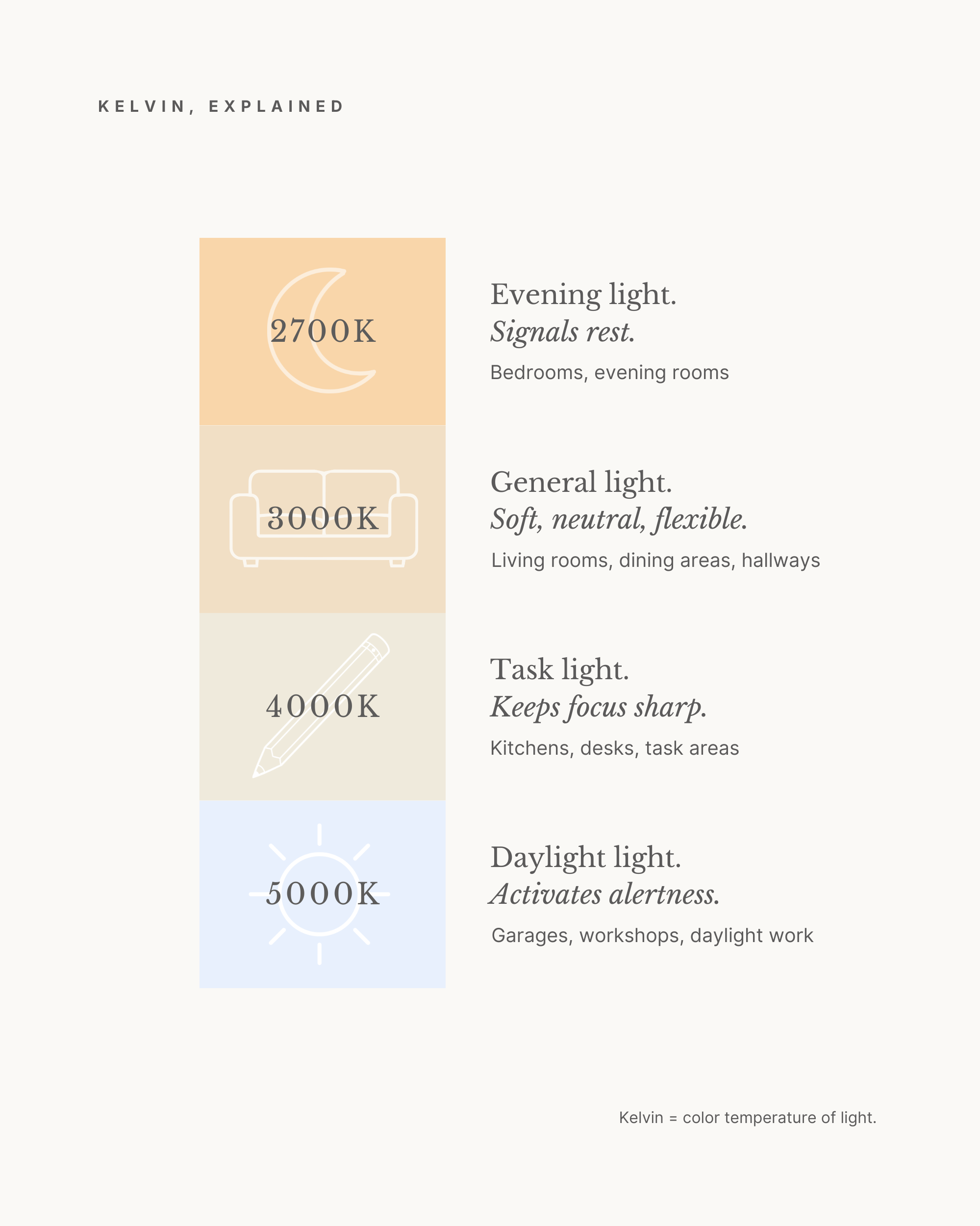
The Kelvin scale, from 2700K warm amber to 5000K cool daylight.
Most parents never read the Kelvin number on the LED box. They grab the pack that says “daylight” or “bright white” because brighter sounds better. That single decision changes how a child’s room feels at night.
Two rules. That is all you need to remember:
Days: 3000K. Evenings: 2700K. Never cooler.
The rest of this guide explains why those numbers work, what the box is really telling you, and how to fix a room that feels off without buying anything new.
What Kelvin actually measures
Kelvin (K) is the color temperature of light. It is not the brightness of the bulb. It is the color the light puts out.
Lower numbers are warmer. They look amber, almost like candlelight.
Higher numbers are cooler. They look blue-white, like a hospital hallway.
The scale most LED bulbs sell at runs from 2700K to 5000K. A few go below or above.
That number is on every LED box. Usually small, near the bottom. Once you know to look for it, you cannot unsee it.
The rule for daytime: 3000K
3000K is soft, neutral, flexible.
It works for a child’s room during waking hours because it gives the room a warm baseline without making it feel like a cave. The light reads as clean. Toys, books, and clothes show their true colors. The child can see what they are doing without the room feeling clinical.
3000K is the temperature I keep in living rooms, dining areas, and most general-use spaces in my own home. It is the most common residential default for a reason.
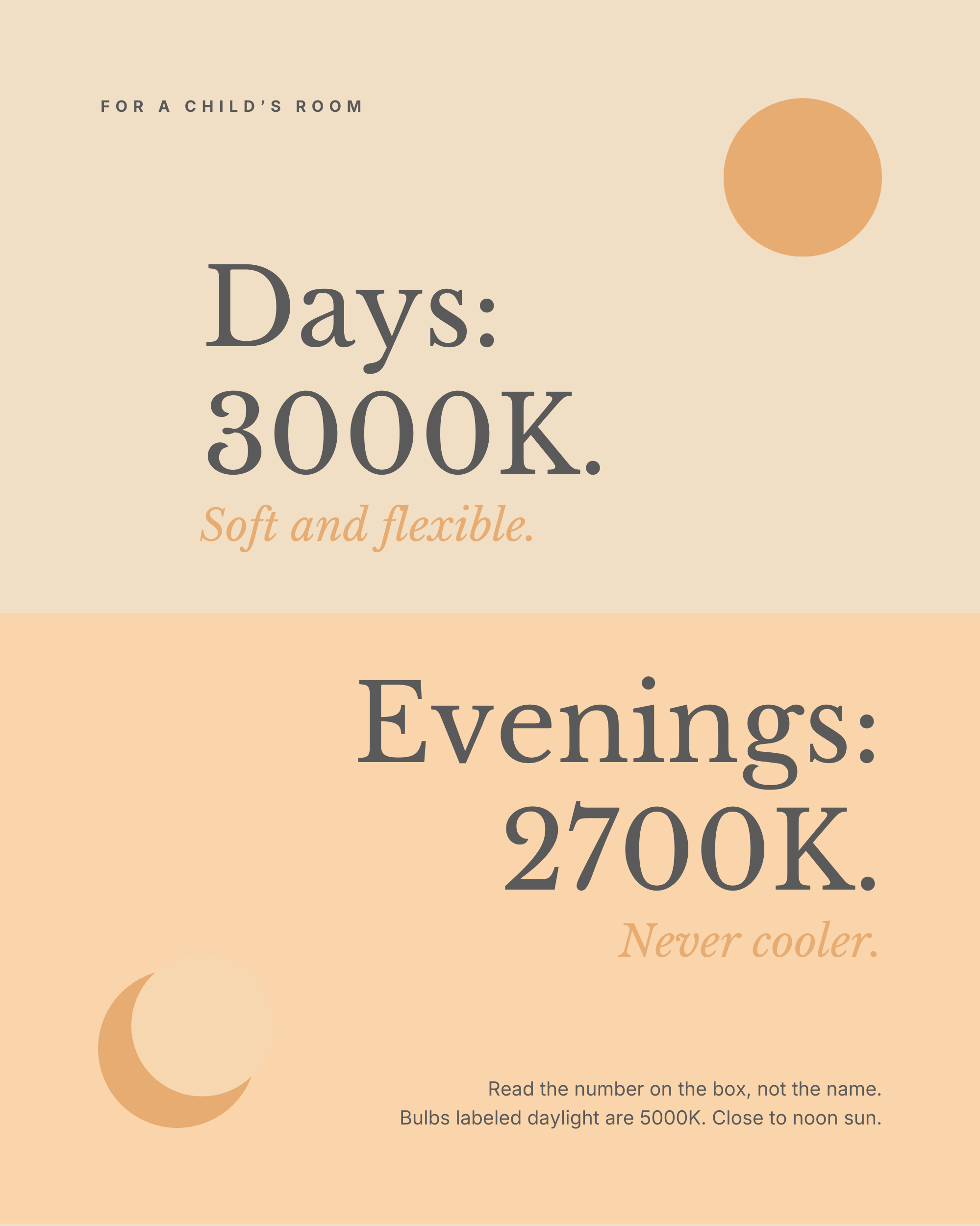
Two rules for a child's room. Days 3000K. Evenings 2700K. Never cooler.
The rule for evening: 2700K. Never cooler.
After sunset, the light in a child’s room should drop to 2700K.
2700K reads as warm amber. The room starts to feel like the light is winding down with the day. The body reads this and starts to wind down too.
There is real research behind this.
A study by Higuchi et al. published in The Journal of Clinical Endocrinology & Metabolism found that preschool-aged children are roughly twice as sensitive to evening light exposure as adults. Their melatonin production is suppressed more strongly and for longer by cool light at night.
The American Medical Association published a statement in 2016 recommending that light above 5700K be avoided in any space used after dark, because of the impact on circadian rhythm.
A child sleeping in a room lit at 4000K or 5000K is being told biologically that it is still daytime.
2700K is the answer. Never cooler in the evening. That is the rule.
How to read the LED box
The most useful thing this article can teach you is this: ignore the name on the box.
“Soft white,” “warm white,” “bright white,” “cool white,” “daylight.” These words are not standardized across brands. One brand’s “soft white” can be 2700K. Another brand’s can be 3000K.
The number is the only thing that does not lie. It is printed on every box, usually near the wattage and lumens.
The bulb labeled “daylight” is almost always 5000K. Close to noon sun. That is the most common reason a child’s room feels wrong at night and no one can figure out why.
Read the number. Not the name.
For parents who want the longer answer
The two-rule framework is enough for most children’s rooms. If you stop reading here, you have what you need.
For parents who want the deeper version, here are the nuances that lighting designers think about.
Dimmable warm LEDs beat fixed 2700K
A dimmable 2700K bulb on a dimmer switch lets you lower the intensity of the room in the evening without changing the color temperature. Lower intensity and warm color together signal sleep faster than warm color alone. If you are buying new bulbs, choose dimmable.
CRI matters too
CRI stands for Color Rendering Index. It measures how accurately a bulb shows the colors of the objects it lights. CRI above 90 is excellent. CRI above 80 is acceptable. Cheap LEDs often have CRI in the 70s, which is why some rooms look flat and washed out even when the Kelvin is correct. Look for 90 or higher when possible.
Where the light comes from matters as much as what it is
Overhead ceiling light, even at 2700K, feels different from a floor lamp at 2700K. Overhead light flattens the room. Lateral and floor-level light layers the room into pools of softness. In my own work I avoid overhead lighting in children’s rooms whenever possible. Two or three lower light sources at 2700K beat one overhead light at any temperature.
A nightlight is a separate decision
If you use a nightlight, the rule goes even warmer than 2700K. Look for 2200K, or a red-tinted bulb. Red and amber light at very low intensity have the smallest effect on melatonin production. White nightlights, even warm ones, are brighter than they need to be for the function they serve.
The room as a system
Light is not a finishing touch. It is part of the architecture of the room. Every other design decision, paint color, furniture placement, textile choice, gets filtered through the light that hits it.
Choose the light like it matters, because it does.
Days: 3000K. Soft and flexible.
Evenings: 2700K. Never cooler.
Read the number on the box. Not the name.
Want a simple system for resetting an overstimulated children’s room in fifteen minutes? Download the free Calm Room Reset guide.